The U.S. Census Bureau keeps track of geographic boundaries for tabulation purposes. In addition to political boundaries such as states and counties, the Census Bureau also creates smaller levels of geography so that data can be tabulated to smaller units. The smallest units are census blocks, followed by block groups and census tracts. The diagram to the right illustrates the hierarchical relationship of these smaller census summary levels.
Below are more detailed descriptions for all of the summary levels for which the Census Bureau tabulates data. All of these census summary levels are available for Caliper mapping software products and include 2020 Census data and most include the latest American Community Survey (ACS) data. Caliper also offers 1990 Census data, 2000 Census data, and 2010 Census data.
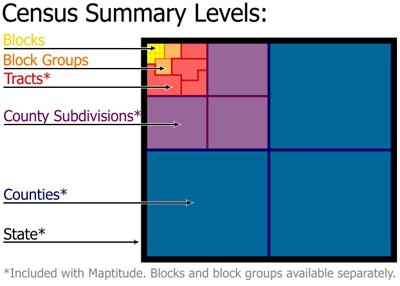
The following summary levels have a hierarchical relationship (reflected in their summary level codes) and are listed from smallest to largest:
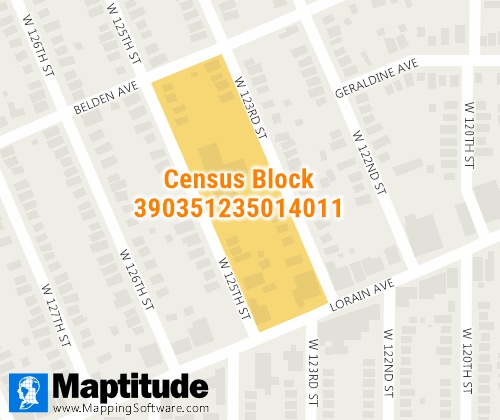
Blocks are the smallest entity for which the Census Bureau collects
and tabulates census information. There are about 8
million census blocks nationwide as of the 2020 Census. In cities, a
census block is typically equivalent to a city block bounded by
streets on all sides. In rural areas, however, a census block may be
larger and bounded by streets, streams, railroad tracks,
pipelines, landmark areas, city
limits, villages, Native American Reservations, or county boundaries.
Available separately from Caliper
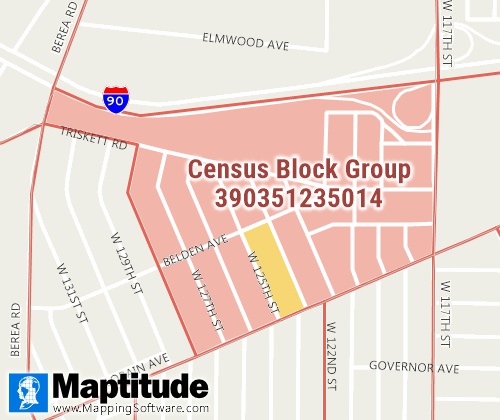
The Block Groups layer contains a nationwide
area database with 242,180 Census Block Groups with Census and
American Community Survey (ACS) demographic data. Block Groups are a
combination of Census Blocks and are also a subdivision of Census
Tracts. Block Groups generally contain between 600 and 3000 people
and are made up of on average 34 Census Blocks.
Included with
Maptitude
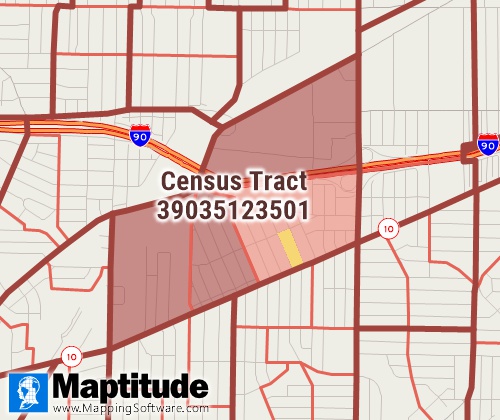
Tracts are a small, relatively permanent statistical subdivision of a
county delineated by a local committee of census data users for the
purpose of presenting census data. Census tract boundaries normally
follow visible features, but may follow governmental unit boundaries and
other non-visible features, and they always nest within counties. Census
tracts are designed to be relatively homogenous units with respect to
population characteristics, economic status, and living conditions at
the time the users established them. They usually contain 1,200 to 8,000
people and are made up of on average about three block groups. There are
85,193 tracts nationwide as of the 2020 Census
(excluding all ocean tracts). The census tract
layer included with Maptitude is ideal for
demographic
mapping and for estimating the demographics of territories or around
sites.
Included with Maptitude and TransCAD
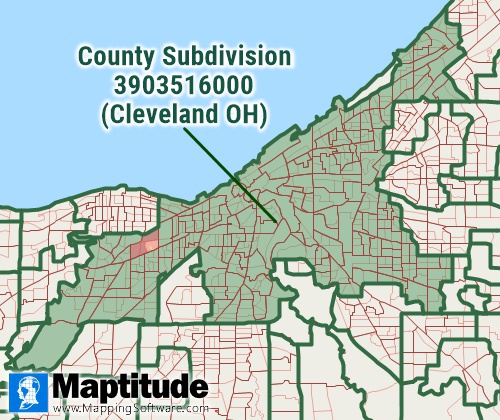
County subdivisions are the primary divisions of counties for the
reporting of decennial census data. They include minor civil divisions
(MCDs are the primary governmental or administrative divisions of a
county such as boroughs, towns, and townships), census county divisions
(CCDs were established by the Census Bureau in 21 states where there are
no legally established MCDs), census subareas, and unorganized
territories.
Included with Maptitude and TransCAD
Counties are the primary legal divisions of most states. In
Louisiana, these divisions are known as "parishes." In Alaska, which has
no counties, the statistically equivalent entities are census areas,
city and boroughs (Juneau City and Borough), a municipality (Anchorage),
and organized boroughs. In Connecticut, which has had no
county governments since 1959, the statistically equivalent
entities are Council of Government (COGs)/planning regions. The entire District of Columbia is considered
equivalent to a county for statistical purposes. The primary legal
divisions of Puerto Rico are termed "municipios" and are treated by the
U.S. Census Bureau, for statistical purposes, as the equivalent of a
county in the United States. The County layer included with Maptitude is
ideal for
demographic mapping of county data.
Included with Maptitude and TransCAD

States are the primary governmental divisions of the United States.
The District of Columbia is treated as a statistical equivalent of a
state for decennial census purposes, as are Puerto Rico and the Island
Areas: American Samoa, Guam, the Commonwealth of the Northern Mariana
Islands, and the Virgin Islands of the United States.
Included with Maptitude and TransCAD

In addition to the hierarchical summary levels listed above, there are a number of additional summary levels for which the Census Bureau tabulates data. These include:
Places include census designated places and
incorporated places. A Census designated place is a settled
concentration of population that are identifiable by name but are not
legally incorporated under the laws of the state in which they are
located. Consolidated cities are where an incorporated place and its
county or minor civil division (MCD) have merged. Incorporated places
are those reported to the U.S. Census Bureau as legally in existence on
January 1, 2020, under the laws of their respective states, as cities,
boroughs, towns, and villages, with the following exceptions: the towns
in the New England states, Indiana, New Jersey, New York,
Pennsylvania, South Dakota, and Wisconsin, and the boroughs in
New Jersey and Pennsylvania are recognized as minor civil divisions for statistical
purposes; the boroughs in Alaska are county equivalents for decennial
census statistical presentation purposes. In four states (Maryland,
Missouri, Nevada, and Virginia), there are one or more incorporated
places known as "independent cities" that are primary divisions of a
state and legally not part of any county. For statistical purposes, the
U.S. Census Bureau may treat an independent city as a county equivalent,
county subdivision, and place.
Included with Maptitude and TransCAD

Caliper's Core Based Statistical Areas (CBSA) layer contains Metropolitan Statistical Areas. Metropolitan Statistical Areas (MSAs) are a geographic entity based on a county or a group of counties* with at least one urbanized area with a population of at least 50,000 and adjacent counties with economic ties to the central area. CBSAs are defined by the White House’s Office of Management and Budget (OMB), with irregular updates every few years.
Micropolitan Statistical Areas are another type of CBSA defined by OMB in a similar fashion to MSAs, but for smaller populations of between 10,000 to 49,999. Caliper provides a separate layer for Micropolitan Statistical Areas. Often OMB and the US Census Bureau treat MSAs and Micropolitan SAs together as a single summary level.
Metropolitan and Micropolitan Statistical Areas are not legally incorporated.
Nesting and Relationships:
Included with Maptitude and TransCAD

Congressional districts are the 435 areas from which members are elected
to the U.S. House of Representatives.
Available Separately from Caliper

State legislative districts
are the areas from which members are elected to
upper (senate) or lower (house/assembly) chambers of
the state legislatures. Nebraska has a single,
unicameral state legislature.
Available Separately from
Caliper

Voting districts are areas, such as precincts, wards, and election
districts, established by state, local, and tribal governments for the
purpose of conducting elections.
Available Separately from
Caliper

School Districts School districts are geographic entities within which
state, county, or local government officials provide public educational
services for the area's residents.
Available Separately from
Caliper

An urbanized area an urban area comprises a densely settled core of census blocks that meet minimum housing unit density and/or population density requirements. This includes adjacent territory containing non-residential urban land uses. To qualify as an urban area, the territory identified according to criteria must encompass at least 2,000 housing units or have a population of at least 5,000. An urbanized area may contain both place and
non-place territory. The U.S. Census Bureau delineates urbanized areas
to provide a better separation of urban and rural territory, population,
and housing in the vicinity of large places.
Included with TransCAD
Traffic Analysis Zones (TAZs) A traffic analysis zone is a special area
delineated by state and/or local transportation officials for tabulating
traffic-related data and usually consists of one or more census blocks,
block groups, or census tracts.
Included with TransCAD
ZIP Code Tabulation Areas (ZCTAs) are geographic areas that the Census Bureau creates from Census Blocks. Each Census Block is part of one distinct ZCTA based on the ZIP Code associated with the most addresses within that block. The Census Bureau creates these once every 10 years as USPS ZIP Code area approximations. They are used for publishing decennial and ACS census data because ZIP Codes do not nest within Census geography. Maptitude ships with the most accurate postal ZIP Code boundaries available. Maptitude does not use ZCTAs (ZIP Code Tabulation Areas) because these are a poor and inaccurate approximation of postal boundaries that are unsuitable for use in business mapping analysis.
* The St. Louis MO-IL MSA also includes the portion of Sullivan MO in Crawford County, since the city spans two counties. The MSAs in Connecticut are now based on the Planning Regions that replaced Counties for statistical purposes.



Home | Products | Contact | Secure Store
 Call Us

