Best Free Mapping Software in 2025 - Top 10 Free GIS Tools

Stewart Berry

Author: Stewart Berry

5 November 2025

Free mapping software has come a long way, offering powerful Geographic Information System (GIS) capabilities without the hefty price tag. In 2025, there are numerous free GIS tools available, some of which can even rival expensive commercial platforms in functionality. These tools enable everyone from students and hobbyists to professionals on a budget to create maps, analyze spatial data, and visualize geographic information.

However, with so many options, choosing the right free mapping software can be challenging. Before deciding, it’s important to consider what features each tool offers, as well as its advantages and limitations. To help you make an informed choice, we’ve compiled a list of the top 10 free GIS mapping software tools for 2025, highlighting key features, pros, and cons of each.

In this article:

10 Best Free Mapping Software in 2025

Choosing a free GIS program means balancing functionality, ease of use, and community support. Each of the following tools provides unique capabilities for mapping and spatial analysis without direct costs. Here are the ten best free mapping software options in 2025, along with their highlights, positives, and negatives:

1. Maptitude Free for Students/Educators and Free Trial - Professional Mapping Suite

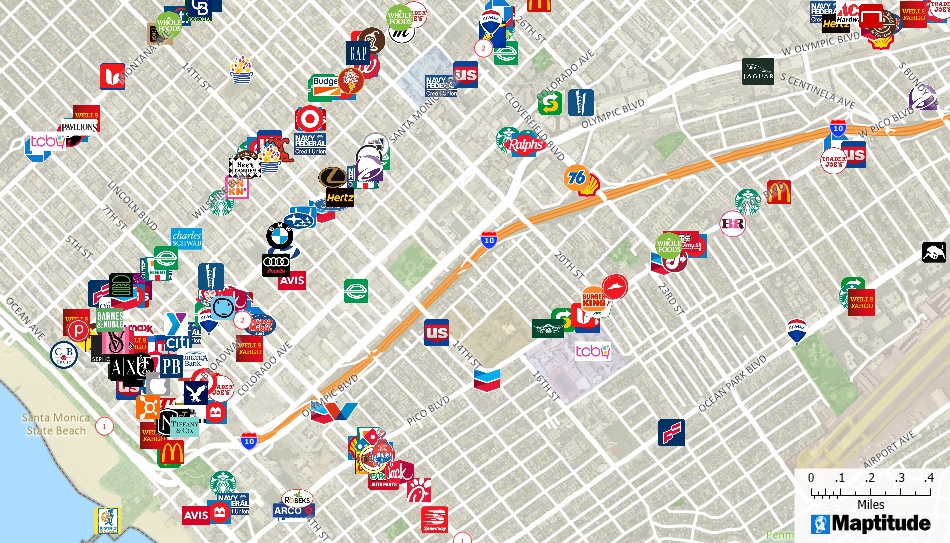
Maptitude business location POI customized logos map

Image © Caliper Corporation. Used with permission from the official Maptitude website.

In 2025, Maptitude added major updates to territory management, data sharing, visualizations, and logistics analytics.

Overview: A full-featured professional GIS that's free for students and educators, and available as a fully functional free trial for others. It includes mapping, routing, territory creation, and spatial analysis tools with rich built-in datasets.

Pros:

Cons:

  • Commercial product; license required after the free trial for non-academic use.
  • Not open source.
  • Advanced features may overwhelm casual users. Limited advanced raster data handling.

Ideal for:

Professionals or organizations needing a complete, data-rich mapping and analysis suite with a free trial option.

Detail:

Maptitude is a full-featured professional GIS and mapping software that is free for students and educators. For everyone else, while commercial, Maptitude has the lowest price on the market and offers a fully functional free trial period. It’s designed for businesses and users who need powerful mapping, spatial analysis, and data visualization tools.

In 2025, Maptitude introduced significant updates, including enhancements to territory management, data sharing, visualizations, and logistics analytics: making it one of the fastest and most intuitive mapping applications available. A standout benefit of Maptitude is that it comes bundled with extensive built-in data (such as demographics, traffic counts, and business locations) right out of the box. This means you can start creating meaningful maps and analyses immediately, without hunting for base data. The software provides an all-in-one solution with features for mapping, unlimited geocoding, routing of as many stops as you want, territory mapping, and more, all accessible through an easy-to-use interface. There are no extra charges for credits, with access to all features of the software at no additional cost.

Because of its comprehensive capabilities and user-friendly design, Maptitude is often regarded as the top choice for professionals who need reliable results quickly. And importantly for this list, the Maptitude free trial gives you full access to these premium features at no cost, allowing you to evaluate its capabilities before committing.

  • Pros: Extremely powerful yet easy to use (an intuitive wizard-driven UI), with a vast range of GIS features and analytics. Includes rich built-in datasets for many countries, saving time on data collection. Professional support is available, ensuring reliability and help when you need it. Many users find it to be the most cost-effective solution given its capabilities.
  • Cons: Maptitude is a commercial product, after the generous free trial period that allows you to run the product without any limitations, continuing to use it requires purchasing a license. It’s not open source, but it is lower cost, and you can depend on Maptitude for updates (they have a strong track record of regular improvements). For casual mappers who need only very basic tools, the extensive features might feel overwhelming (or unnecessary) compared to simpler free apps.
Matt Myers

“If you're still not sure how easy Maptitude is to learn, take advantage of the free trial. Within an hour of install you will be performing trade area analysis and producing maps that will impress your clients or boss.”

Matt Myers
South Pacific Property Advisors
Giuseppe Staiti

“I work with Maptitude on a daily basis for mobility and transport data analyses. Maptitude in its ease of use is undoubtedly the most powerful and feature-rich GIS. Thematic maps are truly unique in terms of graphic capabilities and data representation, highly appreciated by customers. With a low cost combined with an excellent training program and support service, Maptitude is an added value for my business!”

Giuseppe Staiti
Geosam
Andrew Green

“Maptitude contains nearly all of the functionality of other GIS software without nearly as many headaches.”

Andrew Green
Student, UT Dallas


2. QGIS 3 - Feature-Rich Open-Source GIS for All Platforms

QGIS screenshot. Wikimedia Commons.

The 2025 QGIS 3.x release introduced new plugins and improved data format support.

Overview: A leading open-source GIS offering comprehensive map creation, editing, 3D visualization, and analysis tools for Windows, Mac, and Linux.

Pros:

  • Completely free and open source.
  • Extensive plugin library for specialized tasks.
  • Supports many GIS data formats.
  • Active community and frequent updates.

Cons:

  • Steeper learning curve for beginners.
  • Occasional instability with large datasets or many plugins.
  • Relies on community support rather than guaranteed technical help .

Ideal for:

GIS users seeking a powerful, extensible, and community-supported mapping platform.

Detail:

QGIS (Quantum GIS) is arguably the most popular open-source mapping software and has become a cornerstone of the free GIS ecosystem. Now in its 3.x series, QGIS is loaded with professional-grade features for map creation, data editing, geospatial analysis, and cartographic design. It runs on Windows, Mac, and Linux, making it accessible to virtually all users. QGIS’s strength lies in its extensibility and community support: there are hundreds of plugins available to add specialized functionality, from geoprocessing tools to routing and remote sensing.

Recent updates in 2025 have further improved QGIS’s versatility. For example, new plugins and better support for various data formats were introduced, enhancing its functionality and performance. QGIS is one of the few free tools that can truly compete with commercial GIS suites like Esri’s ArcGIS Pro in terms of breadth of features. It also offers advanced capabilities such as 3D visualization, spatial database connectivity, and an integrated Python API for automation and customization.

  • Pros: Completely free and open source, with a large community, which means frequent updates and a wealth of learning resources. Highly extensible via plugins, allowing it to tackle almost any GIS task (from basic mapping to complex spatial analysis). Produces high-quality cartographic outputs and supports a wide range of GIS data formats out-of-the-box. Cross-platform compatibility ensures it works on all major operating systems.
  • Cons: QGIS can have a steeper learning curve for newcomers; its interface and myriad options may be overwhelming, especially for those without GIS experience. While stability has improved greatly, using numerous third-party plugins or very large datasets can occasionally cause performance hiccups or crashes (as with any complex software). Additionally, because it relies on community support, professional technical support isn’t guaranteed (though the online community is active and helpful). Overall, new users might need some patience and training to unlock QGIS’s full potential.


3. GRASS GIS - Established GIS for Advanced Analysis

"GRASS GIS screenshot (SRTM void filling)." Wikimedia Commons

Originally developed by the U.S. Army Corps of Engineers, GRASS remains a trusted analytical GIS used by major research agencies.

Overview: A mature, open-source GIS providing 350+ modules for raster, vector, and terrain analysis that is ideal for environmental and scientific modeling.

Pros:

  • Exceptionally strong in spatial, raster, and image analysis.
  • Free and open source with decades of development.
  • Supports scripting and automation for complex workflows.

Cons:

  • Less user-friendly for casual mapping or design tasks.
  • Outdated-looking interface and limited layout tools.
  • Requires time to learn workflows and terminology.

Ideal for:

Researchers and analysts performing scientific, environmental, or terrain-based modeling.

Detail:

GRASS GIS (Geographic Resources Analysis Support System) is one of the oldest open-source GIS projects, originally developed by the U.S. Army Corps of Engineers and now maintained under the Open Source Geospatial Foundation. GRASS is known for its powerful geospatial analysis and image processing capabilities. It provides over 350 proven modules for raster and vector data manipulation, spatial modeling, terrain analysis, and statistics. This makes GRASS a favorite in academia and among environmental science agencies like NASA, NOAA, and USDA who have used GRASS for its reliability in analytical workflows. The software has an intuitive (though somewhat dated-looking) GUI, but many users also take advantage of its scripting interface for automation. GRASS GIS is excellent for tasks like land cover analysis, hydrological modeling, and satellite image processing. It can be used as a standalone application or in conjunction with QGIS (which can call GRASS tools via a plugin).

  • Pros: Rich suite of analytical tools: GRASS is extremely capable for spatial analysis, remote sensing, and GIS modeling, especially for scientific and environmental applications. It’s free and open source with a long development history, which translates into stable and well-tested functionality. The software supports automation and scripting, which is great for handling large datasets or repetitive tasks.
  • Cons: GRASS is not the most user-friendly for casual mapping or cartography: its interface and workflows can feel challenging for beginners, and it’s not designed for slick map design or interactive mapping outputs. It lacks some of the convenient drag-and-drop style operations that newer GIS programs have. Additionally, its visualization and layout tools are less advanced, so creating polished presentation maps might require exporting data to another tool. Users looking for a modern interface or easy learning curve might prefer other options or need to invest time in learning GRASS’s system and documentation.


4. Whitebox GAT - GIS Toolbox for Hydrology & LiDAR

"Whitebox GAT screenshot." Wikimedia Commons

Created in 2009, Whitebox GAT offers 410+ tools and remains a top choice for hydrological and LiDAR data analysis.

Overview: An open-source geospatial analysis platform focused on terrain, hydrology, and laser-scanning data processing.

Pros:

  • Specialized for hydrology and LiDAR workflows.
  • Over 400 analytical tools available free.
  • Runs as a desktop app or library (Whitebox Tools) for Python.
  • Clean interface for analytical tasks.

Cons:

  • Basic visualization and cartography features.
  • Requires Java runtime.
  • Smaller user community and fewer tutorials.

Ideal for:

Environmental scientists and analysts needing advanced hydrology or LiDAR capabilities.

Detail:

Whitebox GAT (Geospatial Analysis Toolbox) is a relatively young open-source GIS (first released in 2009) that has gained a strong reputation in specialized areas of geospatial analysis. It is a Swiss-army knife for geospatial data processing, with over 410 tools for clipping, converting, analyzing, and extracting information from spatial data. Whitebox is particularly renowned for its hydrological analysis and LiDAR data processing capabilities. In fact, it evolved out of a hydrology-focused project (Terrain Analysis System) and excels at tasks like watershed delineation, flow path modeling, and processing laser scanning (LiDAR) datasets. For example, Whitebox’s LiDAR toolbox offers handy tools (such as converting LAS point clouds to shapefiles) that GIS analysts find extremely useful. The interface of Whitebox GAT is clean and geared towards analytical workflows. It’s actively maintained and available as a library (Whitebox Tools) that can be used in Python or other environments, which extends its versatility.

  • Pros: Focused and powerful for environmental and geospatial analysis, especially for terrain and hydrology tasks that can be more cumbersome in other GIS software. Handles LiDAR data very well, providing advanced capabilities without costly extensions. The toolset is extensive (400+ functions) and the software is completely free and open-source, with an active user community in research circles.
  • Cons: Whitebox GAT’s cartographic and visualization features are relatively basic compared to full-fledged GIS like QGIS. It’s best used as an analytical engine rather than for making presentation-ready maps. Some users might find the need for a Java runtime (since Whitebox is written in Java) to be a minor inconvenience when installing or updating. Also, while the interface is user-friendly for analysis, the documentation and community are smaller than those of QGIS or GRASS, which could mean a bit more effort to find help or tutorials for advanced use cases.


5. GeoDa - Spatial Data Analysis Made Easy

"GeoDa interface." Wikimedia Commons (free license per file page).

Developed at the University of Chicago, GeoDa simplifies spatial data exploration and statistical modeling.

Overview: A free, easy-to-learn spatial statistics tool used in education and research to explore geographic relationships and clusters.

Pros:

  • Excellent for learning and performing spatial statistics.
  • Simple, intuitive interface with example datasets.
  • Includes clustering, regression, and correlation tools.
  • Lightweight and multi-platform.

Cons:

  • Limited mapping and geoprocessing capabilities.
  • Basic cartography and no network analysis tools.
  • Must be paired with another GIS for full functionality.

Ideal for:

Students and researchers exploring spatial relationships or teaching geographic data analysis.

Detail:

GeoDa is a free, user-friendly software tool designed to introduce people to spatial data analysis. Developed originally by researchers at the University of Chicago, GeoDa is not a full-range GIS for map production or complex geoprocessing; instead, it specializes in techniques for exploring data geographically and performing statistical analyses. GeoDa comes with a gentle learning curve and even includes sample datasets so new users can practice and learn with real data. It offers a range of statistical tools, from simple descriptive statistics and box plots to advanced methods like regression analysis and cluster detection, all within a spatial context. Many universities (such as Harvard, MIT, and Cornell) have used GeoDa in teaching to help students grasp the fundamentals of spatial analysis. If your main interest is analyzing patterns, relationships, or trends in location-based data (for example, looking at geographic correlations in socio-economic data or disease incidences), GeoDa provides an accessible platform to do so.

  • Pros: Excellent for statistical analysis of geographic data, with a focus on ease of use for newcomers to GIS. The interface is straightforward and the included example data helps users learn quickly. GeoDa’s specialized tools (like spatial autocorrelation and clustering analysis) are valuable for researchers and analysts working in fields such as economics, public health, or urban planning. It’s lightweight and runs on multiple platforms.
  • Cons: GeoDa is limited in scope: it is not intended for general mapping tasks like making elaborate thematic maps or performing broad GIS data management. Its cartographic capabilities are basic, and it lacks many of the GIS functions (e.g., network analysis, advanced editing of map features) found in more comprehensive software. Essentially, you might use GeoDa alongside another GIS tool: GeoDa for the deep data analysis and another program (like QGIS) for detailed mapping or further spatial processing. Users seeking an all-in-one mapping solution will find GeoDa’s functionality too narrow for their needs.


6. OpenStreetMap - Community-Driven Mapping Platform

"OpenStreetMap homepage" © OpenStreetMap contributors, ODbL. Via Wikimedia Commons

In 2025, OSM data coverage and accuracy improved further thanks to continued global community contributions.

Overview: A collaborative, open-data map of the world that anyone can edit or use freely, often integrated with GIS applications.

Pros:

  • Completely free.
  • Continuously updated global data.
  • Highly detailed maps in many areas.
  • Supports community editing and data export.

Cons:

  • Not a standalone GIS application.
  • Data quality varies by region.
  • Requires external tools for analysis or visualization.

Ideal for:

Users seeking free, editable map data for custom mapping or open-data projects.

Detail:

OpenStreetMap (OSM) is a bit different from the other tools on this list: it’s not a single software package, but rather a free, open-source, community-driven mapping platform and geospatial database. Often called “the Wikipedia of maps,” OSM provides detailed, user-contributed maps of the entire world. Millions of volunteers globally contribute to OpenStreetMap by adding and updating features like roads, buildings, parks, and more. The result is a rich, up-to-date map dataset that anyone can use freely.

For 2025, OSM has continued to grow with significant contributions, making its data more accurate and comprehensive than ever. You can interact with OpenStreetMap via its website (for basic viewing and editing) or through various third-party applications and GIS software that leverage OSM data. Many free mapping tools (including some on this list such as Maptitude) allow you to import OSM base maps or data. Using OSM, you can also create custom maps for web or print, or perform analyses if you extract the data. It’s especially valuable for projects that require up-to-date local geographic information without licensing fees.

  • Pros: Completely free and open data: no licensing fees or restrictions, which makes it ideal for any budget. OSM’s data is incredibly detailed in many areas (often more so than commercial datasets), and it is constantly updated by a passionate global community. The collaborative nature means if something is missing or outdated, you can contribute improvements yourself. There’s a wide range of applications for OSM data, from navigation and routing to map visualization and research.
  • Cons: OpenStreetMap by itself is not a full GIS software: it’s primarily a data source and basic online editor/viewer. For advanced analysis, you’d need to use OSM data within another GIS tool. While the community is quick to improve the map, data quality can vary by region (some places are mapped in extreme detail, others less so, depending on contributor activity). Also, OSM doesn’t natively provide the analytical tools or advanced cartographic functions that dedicated GIS software does. Using OSM data might require some technical steps (for example, downloading data extracts or using APIs), which can be a hurdle for non-technical users. Essentially, think of OSM as a foundation of free map data and a collaborative mapping platform, rather than a one-stop GIS solution.


7. uDig - User-Friendly Desktop Internet GIS

"uDig screenshot." Wikimedia Commons (CC BY-SA: attribution & share-alike).

uDig emphasizes simplicity and supports online GIS protocols like WMS and WFS across major platforms.

Overview: A lightweight, open-source desktop GIS offering an approachable environment for viewing, styling, and basic spatial analysis.

Pros:

  • Simple, uncluttered interface ideal for beginners.
  • Supports standard data formats and web map services.
  • Cross-platform and open source.
  • Includes live coordinate tracking and XML styling.

Cons:

  • Limited analytical and cartographic depth.
  • Slower development pace with fewer updates.
  • Smaller community and less documentation.

Ideal for:

New GIS users needing straightforward tools for viewing and light mapping.

Detail:

uDig (User-friendly Desktop Internet GIS) is an open-source GIS application aimed at providing a straightforward, lightweight mapping experience. As its name suggests, uDig emphasizes a user-friendly interface and has strong support for internet GIS protocols. It runs on Windows, Mac, and Linux. The acronym “uDig” actually hints at its design: u for user-friendly, D for desktop (cross-platform), I for internet-oriented (it easily consumes web map services like WMS/WFS), and G for GIS-ready for basic analysis. In practice, uDig offers a clean and simple environment where you can load various data sources (shapefiles, PostGIS databases, WMS layers, etc.), style maps, and perform modest analysis. It uses the GeoTools rendering engine and the Eclipse Rich Client Platform for its interface. uDig is often praised for being approachable, especially for those who don’t need the full complexity of QGIS. It’s a good option for basic mapping projects or as a viewer for GIS data.

  • Pros: Easy to use interface with an uncluttered design, making it inviting for new GIS users or those who want to do simple mapping without wading through too many options. Supports standard GIS data formats and web map services, which is great for pulling in base maps or data from online sources. Being cross-platform is a plus for Mac and Linux users looking for a free GIS. uDig also has some neat features like live coordinate tracking and an XML-based styling system.
  • Cons: uDig is a lighter-weight GIS, which means it has a more limited toolset compared to heavyweights like QGIS or GRASS. Users may quickly hit the ceiling of what it can do if they require advanced analysis or extensive cartographic customization. For instance, it doesn’t have nearly as many plugins or specialized tools. The development activity for uDig has slowed in recent years, which can translate to fewer updates and lingering minor bugs (some users have noted stability issues at times). Additionally, the community around uDig is smaller, so finding support or tutorials is not as easy as with more popular software. In summary, uDig is ideal for simple projects, but power users will likely find it insufficient for complex tasks.


8. gvSIG - Open Source GIS with 3D and Mobile Support

"gvSIG screenshot." Wikimedia Commons (CC BY 2.5 / GFDL / CC BY-SA 3.0)

Originating from Spain, gvSIG includes 2D/3D visualization, CAD tools, and gvSIG Mobile for Android.

Overview: An open-source GIS with advanced visualization, editing, and field-data collection capabilities.

Pros:

  • Robust 2D, 3D, and mobile GIS features.
  • Includes CAD-like editing via OpenCAD Tools.
  • Integrates desktop and field workflows.
  • Active international community.

Cons:

  • Smaller English-language community.
  • Resource-intensive on older systems.
  • Installation and extensions can be complex.

Ideal for:

GIS professionals needing 3D, CAD, or mobile data collection in an open-source environment.

Detail:

gvSIG is a professional-grade open-source GIS originating from Spain. It offers a broad set of GIS capabilities, including 2D and 3D visualization, and even a mobile GIS application for field data collection. gvSIG has often been highlighted as an underrated alternative in the free GIS arena, as it packs quite a few advanced features. For example, gvSIG includes a robust set of CAD-like editing tools (via its OpenCAD Tools extension) that allow for precise drawing and editing of spatial data. You can snap, split, and modify geometries in ways similar to CAD software. It also provides a table interface called the NavTable that lets you scroll through attribute tables record by record in a user-friendly way. The 3D capabilities enable viewing and navigating terrains and city models, adding an extra dimension to analyses. Moreover, gvSIG Mobile is available for Android, which is quite useful for GIS data collection and viewing on the go. The gvSIG project has a strong international user base and is known for hosting an annual conference.

  • Pros: Feature-rich: offers tools not only for typical GIS analysis and mapping, but also integrates CAD tools and 3D visualization, which some other free tools lack. The existence of gvSIG Mobile sets it apart, providing continuity between desktop GIS work and field work. Being open source, it’s free to use and has an active community, particularly in Europe and Latin America. The interface will feel familiar to GIS users (somewhat similar to ArcGIS in layout), easing the learning curve.
  • Cons: While gvSIG offers an impressive range of GIS tools, its global user base is smaller than that of QGIS, which means community discussions and tutorials, especially in English, are less extensive. The majority of gvSIG’s documentation and support resources are in Spanish, though English materials and forums are available and steadily improving. The software can be demanding on system resources, so performance may slow when handling very large datasets or running on older computers. Some users also find that the interface, though feature-rich, has a steeper learning curve, and that installing or managing extensions isn’t as streamlined as in some other GIS packages. Overall, gvSIG is a powerful open-source GIS, best suited for users comfortable navigating a multilingual environment and looking for advanced capabilities.


9. MapWindow GIS - Lightweight GIS with Plugin Extensibility

"MapWindow GIS screenshot." Wikimedia Commons (free screenshot of FOSS: see file page license)

MapWindow 5, the current version, is a .NET-based Windows GIS offering core tools and plugin flexibility.

Overview: A free, open-source desktop GIS providing essential mapping, editing, and analysis features with extendable plugins.

Pros:

  • Simple interface for common GIS tasks.
  • Plugin architecture for specialized functions.
  • Integrates tools like TauDEM and HydroDesktop.
  • Well-suited to Windows environments.

Cons:

  • Windows-only; not fully cross-platform.
  • Dated interface and smaller user base.
  • Limited for advanced or large-scale GIS projects.

Ideal for:

Windows users needing a lightweight GIS with extendable analytical tools.

Detail:

MapWindow GIS is a free and open-source desktop GIS that is particularly popular among Windows users. (As the name implies, it was originally built for Windows; the current MapWindow 5 is a .NET-based application.) MapWindow was once a proprietary product that became open-source through a U.S. EPA initiative, and it has since evolved into a capable lightweight GIS platform. The latest version, MapWindow 5, provides a user-friendly interface for viewing and editing spatial data, and it covers about “90% of what GIS users need” for everyday mapping tasks. You can perform basics like adding data layers, styling maps, identifying features, and printing layouts. MapWindow also shines in its extensibility: it has a plugin architecture and has incorporated specialized tools such as TauDEM (for automated watershed delineation and hydrological analysis) and HydroDesktop (for discovering and managing water data). These and other plugins (like DotSpatial for developers) allow users to add specific functionalities as needed, making MapWindow a flexible option for those who might want to customize or extend their GIS.

  • Pros: Easy to use for common GIS tasks: ideal for someone who needs a simple map viewer/editor with analysis capabilities but doesn’t want the complexity of larger suites. Covers essential functions like layering, attribute queries, and map layout without much fuss. The plugin system is a big plus, as it lets you enable advanced features (such as hydrological analysis) on top of the core application. MapWindow is also free and open-source, with an active niche community, and is particularly well-suited to Windows environments (it integrates nicely with other .NET tools).
  • Cons: Windows-only: it’s largely tied to the Windows OS (there have been efforts to make parts cross-platform, but the main application is Windows-centric), which is a drawback for Mac/Linux users. The user interface, while straightforward, is not as modern or polished as some other tools; it may feel a bit outdated. MapWindow’s smaller user base means fewer third-party tutorials or help forums compared to something like QGIS. Additionally, for very advanced GIS needs (e.g., complex spatial modeling or high-end cartography), MapWindow might not have all the tools available even with plugins being best for small to medium projects.


10. SAGA GIS - Geoscientific Analysis Powerhouse

"SAGA GIS screenshot." Wikimedia Commons (GPL / free screenshot: see file page)

Initially designed for terrain analysis, SAGA GIS continues to evolve as a core geoscientific GIS platform.

Overview: A free, open-source system optimized for terrain, hydrology, and environmental modeling, often used alongside QGIS.

Pros:

  • Extensive terrain and environmental analysis tools.
  • Fast raster processing and scripting support.
  • Lightweight and efficient.
  • Actively developed and open source.

Cons:

  • Limited map design and layout features.
  • Dated interface and terminology-heavy workflow.
  • Smaller, research-focused community.

Ideal for:

Scientists and GIS professionals focused on geospatial modeling, terrain, or climate data analysis.

Detail:

SAGA GIS (System for Automated Geoscientific Analyses) is a free, open-source GIS that has gained popularity especially in the environmental science and geoscience communities. As the name indicates, SAGA was initially developed with a focus on terrain and geospatial analysis: tasks like digital elevation model (DEM) processing, hydrological modeling, and climate data analysis. It provides a fast and comprehensive set of geoscientific methods, and over the years it has expanded into a more general GIS tool.

SAGA’s interface allows multiple windows (maps, histograms, scatterplots, etc.) for simultaneous analysis views, and it offers both a GUI and an API, which makes it scriptable for power users. Unique algorithms in SAGA include things like its own topographic wetness index computation, terrain ruggedness measures, and other specialized raster analysis tools. Many users employ SAGA in conjunction with other GIS software: for example, QGIS can call SAGA algorithms through its processing toolbox, effectively using SAGA as a behind-the-scenes engine for heavy analysis. SAGA is known to be quick and efficient in processing, and it continues to be updated by a community of researchers and developers.

  • Pros: Excellent for terrain and environmental analysis. SAGA provides many specialized tools that are either unique to it or hard to find elsewhere in one package. It’s relatively lightweight and can handle large raster computations swiftly, often faster than other GIS software. The interface is fairly straightforward for running analyses, and the ability to script or batch process is a plus for advanced users. SAGA is completely free and open-source, making it easy to integrate into academic or research workflows. It’s a go-to choice for tasks like watershed delineation, climate data interpolation, and landform classification.
  • Cons: SAGA GIS is not focused on cartography or general-purpose mapping. Its map layout and visualization options are quite limited, so it’s not the best choice if your goal is to produce polished maps for presentation. The UI, while functional, is a bit dated and can feel less intuitive for those accustomed to modern design. Some operations might require understanding the specific terminology and structure that SAGA uses. Additionally, while SAGA’s user community is dedicated, it’s smaller than the QGIS community, meaning you might have to dig through academic forums or documentation for support. For many users, SAGA is something they use alongside a primary GIS program, rather than as their only mapping tool.


Key Features to Look for in Free GIS Mapping Software

Not all free GIS tools are equal. Evaluating features carefully will help you choose software that fits your data, goals, and workflow. These are the essential factors to consider and how our number one choice Maptitude compares as a complete professional alternative.

Data Format Support and Compatibility

  •  The best GIS software handles many data types without extra conversions. Look for support for formats such as Shapefile, GeoJSON, KML, and CSV, and the ability to connect to spatial databases such as PostGIS or Spatialite.
  • Broad compatibility ensures you can integrate diverse datasets smoothly.
  • Free tools such as QGIS or SAGA support a wide range of formats, while Maptitude includes built-in import and export options for virtually every major file type so you can combine data from multiple sources in one project.

Analytical Capabilities

  • Your choice should match your analytical needs. Some free GIS software is best for simple mapping, while others such as GRASS or SAGA specialize in advanced spatial modeling, raster processing, and network analysis.
  • If you need specific functions such as LiDAR processing, spatial regression, or routing, confirm that the features are included.
  • Maptitude delivers strong vector data capabilities in a single environment without the need for external plugins, providing thematic mapping, drive time rings, geocoding, and territory analysis all out of the box.

Ease of Use and User Interface

  • The learning curve is important, especially for new users. Interfaces like those in GeoDa and uDig are approachable, but some open-source tools require scripting and setup time.
  • Look for drag-and-drop data loading, visual map styling, and step-by-step wizards that guide you through tasks.
  • Maptitude combines professional power with an intuitive point-and-click interface so you can produce meaningful maps quickly without coding or plugin management.

Performance and Scalability

  • Free software should still perform well with large or complex data. QGIS and SAGA can process heavy raster or vector analyses, while lighter tools may slow down with big projects.
  • If you plan to scale up over time, make sure your software is actively developed and optimized.
  • Maptitude is designed to handle nationwide vector datasets and complex analyses efficiently, offering high performance on large files and smooth scalability as your projects grow.

Community and Support

  • Community involvement affects how reliable a free tool will be. QGIS benefits from a large active user base and frequent updates, while smaller projects may have limited documentation or fewer contributors.
  • Check for recent tutorials, user forums, and available help resources.
  • Maptitude provides direct customer support, extensive documentation, and training resources, giving you dependable assistance beyond community forums.

Advanced Features and Extensibility

  • Consider your advanced needs such as 3D visualization, field data collection, GPS integration, or automation through scripts. Tools like gvSIG support 3D and mobility, and QGIS has plugin extensions.
  • Maptitude also includes an automation and customization API (GISDK) and supports add-ons for advanced functions, ensuring the software can evolve with your needs and technology trends.

License and Data Usage Rights

  • Always confirm that the software is free for your intended use. Many open-source programs are free for both personal and commercial work. If you are trying a commercial product such as Maptitude, check the trial duration and pricing after the evaluation period.
  • Also review open-data license terms when using sources like OpenStreetMap to ensure compliance.
  • Maptitude provides a free trial for full evaluation, free licenses for academia, and transparent licensing for continued use, so there are no surprises as your work expands.

Choosing the Best Free Mapping Software

Free GIS tools can be powerful, but the right one depends on your goals, data, and experience level. Here is how they compare and why many users eventually move to Maptitude for a complete professional solution.

Best for Beginners

If you are new to GIS, look for simplicity:

  •  GeoDa is easy to learn for spatial analysis and includes helpful examples.
  • uDig and MapWindow GIS are good for quick map viewing, light editing, and basic analysis.

These are excellent starting points, but their capabilities are limited compared to professional tools such as Maptitude, which provides the same simplicity with far greater analytical depth.

Best for General Purpose GIS

For all around mapmaking and analysis:

  • QGIS is a strong open-source option with an extensive plugin library.
  • gvSIG includes desktop, mobile, and 3D features, though its interface can be challenging.

These tools are suitable for users who enjoy exploring plugins and managing data manually. For those who want a single reliable system that simply works, Maptitude combines map design, data editing, and analysis in one seamless environment without the need for plugins or scripting.

Best for Advanced Analysis

Researchers and data scientists often prefer:

  • GRASS GIS and SAGA GIS for environmental and terrain modeling.
  • Whitebox GAT is excellent for hydrological and LiDAR work.

These are powerful analysis platforms but not ideal for presentation or business use. You may also mix tools for best results, for example process LiDAR in Whitebox and finish cartography in QGIS. Maptitude excels at vector data handling with polished visualizations and complete data packages so you can move effortlessly from raw data to professional results.

Best for Community and Open Data Projects

For collaborative or open data mapping

  • OpenStreetMap is invaluable for crowd sourced and frequently updated basemap data.
  • It can be paired with tools such as QGIS for further editing and analysis.

These free tools serve NGOs and civic mappers well but require more setup and manual data work. Maptitude includes detailed worldwide data such as streets, demographics, and business listings ready for immediate use with no configuration required.

Support and Long-Term Reliability

Free projects vary in consistency:

  • QGIS is widely supported and regularly updated, while others such as gvSIG or uDig may not be maintained as frequently.

For ongoing performance, dedicated support, and guaranteed compatibility, Maptitude delivers a commercially maintained system with continuous development, technical assistance, and regular data updates that keep your work secure and reliable.

Try Maptitude Free

Free GIS tools are excellent for learning and experimentation. Yet when you need greater power, deeper data integration, or professional presentation, Maptitude provides everything in one complete mapping solution.

You can try Maptitude at no cost through a free trial or a personal demo. The trial gives full access to every feature, including thematic mapping, drive time analysis, routing, and territory management, all within an intuitive interface. Many teams rely on Maptitude for market analysis, site selection, and transportation planning.

Students and educators can also request a free one-year educational license, making Maptitude ideal for research, teaching, and academic projects.

Next Steps

Try Maptitude for free today and experience how its comprehensive tools enhance spatial analysis, planning, and decision making. Whether you are managing a business expansion, analyzing markets, or conducting research, Maptitude gives you everything you need to create accurate and meaningful maps with confidence.

Free Trial Request a Demo  Buy Now 


Related Articles

Find Us 1172 Beacon St., Suite 300
Newton MA 02461 USA

Home  |  Products  |  Contact  |  Secure Store

Copyright © Caliper Corporation